
 Contact
  Account


Important update for dog owners: Dogs traveling from the United States to Mexico need a New World screwworm inspection certificate. A USDA-accredited veterinarian must examine the dog and sign the certificate within five days before the dog enters Mexico. Cats are not included in this new rule.
Pets are our family members, and many of you will likely plan your move to Mexico around your furry friends comfort.
With this quick guide, I hope to help you answer the questions of
- How do you bring your pets if you’re driving to Mexico?
- How do you bring your pets if you are flying?
- What documents do you need to have handy?
- A travel with pets checklist
- How to find services that bring your pets from the USA/Canada to Mexico?
- And what resources you can look into to help you make the move?
- Plus, information on traveling back to the U.S. with pets

Your Pets Checklist
3 months before
- Ensure rabies vaccination is current.
- Contact a pet transporter from the online guide to book pet travel or
- Book your flight and confirm pet cabin/cargo option
1 month before
- Purchase airline-approved carrier
- Begin carrier training with your pets
- Research pet-friendly housing at destination
15 days before (for non-US origin)
- If traveling from outside US/Canada or your airline requires it, visit vet for health certificate (must be issued no more than 15 days before arrival, present original and copy).
- Confirm flight booking and pet reservation if applicable
5 to1 days before
- Obtain Screwworm certificate from USDA accredited veterinarian for your dogs. The exam cannot be older than 5 days from your travel date.
Travel day
- Bring all original documents in hand luggage. Not in your checked luggage
- Arrive early for pet check-in procedures
- Carry comfort items (familiar blanket, treats)
- Have destination emergency vet info saved
Driving to Mexico with Pets
Mexico DOES NOT officially require a health certificate if your pet is traveling from Canada or the U.S.
That means you can drive to the border without needing a health certificate.
However, there are still some steps you have to follow per the USDA.
When you arrive at the border, an agent will ask you, “algo que declarar?” (something to declare?)
You should declare any living animals. So please let the border agents know you have a dog/cat.
They will instruct you to pass to the SENASICA offices for a physical inspection of your pets. They will have you fill out a form to declare the importation of your pets.
Also, according to Mexican customs laws, you can bring up to 2 animals per person into Mexico. Even though this is rarely enforced when you are driving to Mexico.
After two pets, you may be asked to pay an import fee per pet. The average fee for 3 pets or more is $1620 MXN or about $90 USD
You may read other people’s stories that many border agents in Mexico might not inspect your car or your pets, and may just waive you through to cross the border.. because In Mexico, many times enforcement is inconsistent at land borders. But don’t assume anything, and drive off without declaring your pet.
Requirements
- Upon arrival to Mexico with your pet dogs and/or cats, travelers must visit the Mexican Animal and Plant Health Inspection Office (OISA) to contact the official personnel working with SENASICA. They are usually in the same office.
- The official personnel will verify the following:
- That the dog(s) and/or cat(s) do/do not present signs of infectious and contagious diseases. The animal(s) does/do not present fresh wounds or wounds in a healing process. Suppose your pet is being treated for lesions and/or infections due to a skin condition. In that case, you should present the SENASICA agent with your Veterinarian’s diagnosis and treatment instructions. This information should be presented on letterhead, including the Veterinarian’s professional registration number (or equivalent).
- The animal(s) is/are free of ectoparasites.
- The animal has all current shots, most importantly rabies.
- Present a Screwworm Inspection Certificate for all dogs traveling to Mexico.
- A USDA-accredited veterinarian must examine the dog and sign the certificate. The examination and certificate must be completed within 5 days before entering Mexico. You must carry the completed certificate and present it to SENASICA/OISA officials when entering Mexico.
- For food, a family may generally bring one unopened, clearly labeled bag of dry pet food weighing up to 50 pounds, or about 22.7 kilograms, when the product and its ingredients are allowed to enter Mexico. Please remember almost all pet food is also available in Mexico
Please remember that in Mexico, only cats and dogs are considered pets. Bringing reptiles or birds is a separate process. And quite honestly, not a super easy process. 😅
Again, many times at the land borders, customs agents will just waive you through without asking you to actually stop at the SENANSICA office or without making you stop for a physical inspection of your pets.. If that’s the case, it’s ok to drive through. However, if a customs agent asks you to stop at the customs offices, please bring your pets and the proper pet documentation with you.
Flying to Mexico With Pets
Even though Mexico does not require a health certificate if your pets are coming from Canada or the USA, the airline which you fly with could require it.
Before you fly with a pet into Mexico, you must find out what the airline requirements are and whether airlines allow pets to go in cargo or the cabin. Because each airline has its requirements.
Some will not put pets in cargo in the summer, and some will not allow more than 2 animals per flight.
Another thing you’ll have to consider is that Mexican customs law states that you are allowed to bring up to 2 animals per person into Mexico.
After 2 pets, you may be asked to pay an import fee per pet. However, this is up to the customs agent at the airport. Most people flying with more than 2 pets will ask a family member or friend to bring their additional pet.
When You Get To An Airport
Your pet is on your same flight. You drop them at the ticket counter and pick them up near the oversized luggage area. Your pets are usually unloaded first, if they flew in the cargo area of your flight.
Look for the SENASICA office near the luggage area, and that is where crates are left for processing. But do keep in mind, you handle the SENASICA inspection yourself in the arrivals hall.
Mexican regulation requires that pet carriers contain no hay, straw, or cloth bedding. To prevent the spread of organic pests or seeds.
Use a specialized absorbent “puppy pad.” Do not put your pet’s favorite expensive bed in the crate; it could be confiscated and thrown away by the inspector.
You are only allowed to bring enough “open” pet food for one day’s ration. Sealed bags (up to 50lbs) are generally okay, but multiple “Ziploc” bags of food are usually tossed.
Cargo pets can take 1 to 8 hours to be processed. If your pet lands after 6PM, there could be a risk they won’t clear customs until the following morning. So try to book the earliest arriving flight. Also, if you have a connecting flight, do not expect to walk out of the airport with your cargo pet 30 minutes after you land.
Also, just so you’re aware- SENASICA does not charge you for the inspection and importation of a pet into Mexico.
Requirements
SENASICA is the official zoosanitary authority in Mexico. These are the officials that will carry out a physical exam of your pets when coming to Mexico. Look for their offices at the baggage claim area of your final destination.
And they state their requirements are:
- If you are traveling from a country other than the USA/Canada, submit a Health Certificate valid for at least 15 days after issuance and containing the following items. The certificate must be issued by an official veterinarian of the competent authority or a private practice veterinarian.
- Date of application of the rabies vaccine and validity
- (animals younger than 3 months old are exempt from this requirement)
- Present a Screwworm Inspection Certificate for all dogs traveling to Mexico.
- A USDA-accredited veterinarian must examine the dog and sign the certificate. The examination and certificate must be completed within 5 days before entering Mexico. You must carry the completed certificate and present it to SENASICA/OISA officials when entering Mexico.
- The animal(s) must have been found clinically healthy at the inspection before their trip.
- The animal(s) must have been dewormed within the past six months and must be free of ectoparasites or lesions.
- Your pet must be carried in a clean crate or container, without a bed or accessories (toys, treats). They may be thrown away by inspectors. The crate or container will undergo preventive treatment through spraying by official personnel from the Secretary of Agriculture in Mexico-SENASICA.
- Your pet can enter with its collar, leash, etc.
- You can carry up to a 50lb or 22kg bag of dry pet food per family. If you bring bags of food in a Ziploc or another unbranded bag, then you can only bring the ration for a day. But don’t worry, most dog food brands you are familiar with are available for purchase in Mexico.
Screwworm Certificate
As of August 3rd 2026, You must obtain the specific New World Screwworm Inspection Certificate for all dogs traveling to Mexico or back through the U.S.
A USDA-accredited veterinarian must examine the dog and sign the certificate for dogs traveling to Mexico.
The examination and certificate must be completed within 5 days before entering Mexico. The template for all veterinarians can be found here.
I’ve called around different vets and Screwworm certificates cost $70-$250 per pet depending on the veterinarian that issues the certificate
Vaccines/Shots
Make sure your pet is up to date on its rabies and deworming shots. Depending on the airline, your pet’s vaccines should be administered at least 30 days before travel dates.
Confirm Costs With Airlines
Some airlines require phone reservations for pets in cabin and/or cargo. However, more and more airlines allow online bookings. The cost of this is approximately:
- In-Cabin (Small dogs/cats): Fees range from $125 to $150 USD each way.
- Checked Baggage/Cargo (Large dogs): Fees range from $250 to $600 USD.
Service Animals
You may bypass the restrictions of weight and size for your pet to fly in cargo if for example, your pet is certified as a “service animal” and you have a letter from your doctor certifying the reason you need a service animal. But please don’t attempt to get your pet on the plane by buying an online “service animal” certificate – the airlines are onto those schemes.
Health Certificate
Depending on which airline you and your pet are traveling on, your health certificate should be issued within 10-15 days of travel. Mexico does NOT require a health certificate for pets traveling from Canada or the USA. However, the airlines are private businesses, and usually DO require a health certificate.
Work With An Expert
There are times when you may be moving to Mexico with more than one pet. Or you may be moving to Mexico on one visit and plan for your pets to catch up to you on a different occasion once you are settled in.
Or you may not want to put yourself r your dogs/cats through the stress of flying or figuring out Mexican bureaucracy on your own.
Regardless of your situation, you may need some extra help.
For this reason, we have some excellent pet transport recommendations. For a fee, you can hire an individual to fly to the USA or Canada to bring your pets down to Mexico. Their fees are usually around 5-8k USD for land transport.
Some of them will take pets, and a small household goods load. Some will allow you to travel with them, and some will only take pets. Each company is different.
Accessing Our Vetted Contacts
We have spent years vetting pet transporters who actually “walk the walk.” and have a ton of experience getting pets to Mexico from the U.S. and Canada.
And we only recommend professionals who have a proven track record of navigating Mexican roads and customs. Knowing the current USA and Mexico land border requirements. And those have great reviews from previous clients.
Note: We provide the names and contact info for our vetted pet transporters and other vetted contacts exclusively inside our Complete Mexico Relocation Guide. These include ground transportation as well as private jet charters.

Other Tips and Resources

To consider when choosing an airline for your pet:
Some airlines have restrictions on pet transport during extreme summer or winter months. Check this first!
Most airlines will allow you to take a small pet in the cabin as long as your pet meets certain weight and size restrictions. Check with the airline to know how many pets you can take per person.
If your pet isn’t used to being in a kennel for long periods of time, consider getting them used to their travel kennel a few months before your travel. Put some toys or blankets in their kennel to train them in the meantime. That way, on travel day, they will be less stressed.
If at all possible, try to arrange for your pet’s flights to be as direct as possible. The less time your pet has to spend traveling, the less stress they will experience.
To find dog-friendly lodging across Mexico, we recommend using BringFido.com, Booking.com, or Airbnb.com and using the “pet friendly” filters.
Traveling Back to The U.S. With Pets
If you are traveling to and from Mexico -As of 2024 the CDC has new requirements for pets (all dogs and cats, including service animals) entering the USA from a foreign country.
- Your cats or dogs must have a Screwworm certificate from an accredited Mexican veterinarian stating your pets are free of screwworm. Screwworm certificates should not be older than 5 days.
- Your pet dogs must be microchipped. Animals are not scanned, and only the documents for the microchip are needed.
- You should fill out the CDC form (below) stating your pet was NOT in a rabies high risk country in the past 6 months. (FYI- Mexico is NOT on the list of high risk countries for rabies. However, if you pass through Mexico from another country, you may need to check the list.)
This form can be filled out on the day of travel online, and the receipt can be shown to airlines and border officials by printed copy or phone.
The receipt will be good for travel into the U.S. for six months from the date of issuance, including multiple entries. All dogs entering the United States must have a microchip and be over six months of age.
More information can be found through the CDC.
Screwworm Certificate to Enter the USA
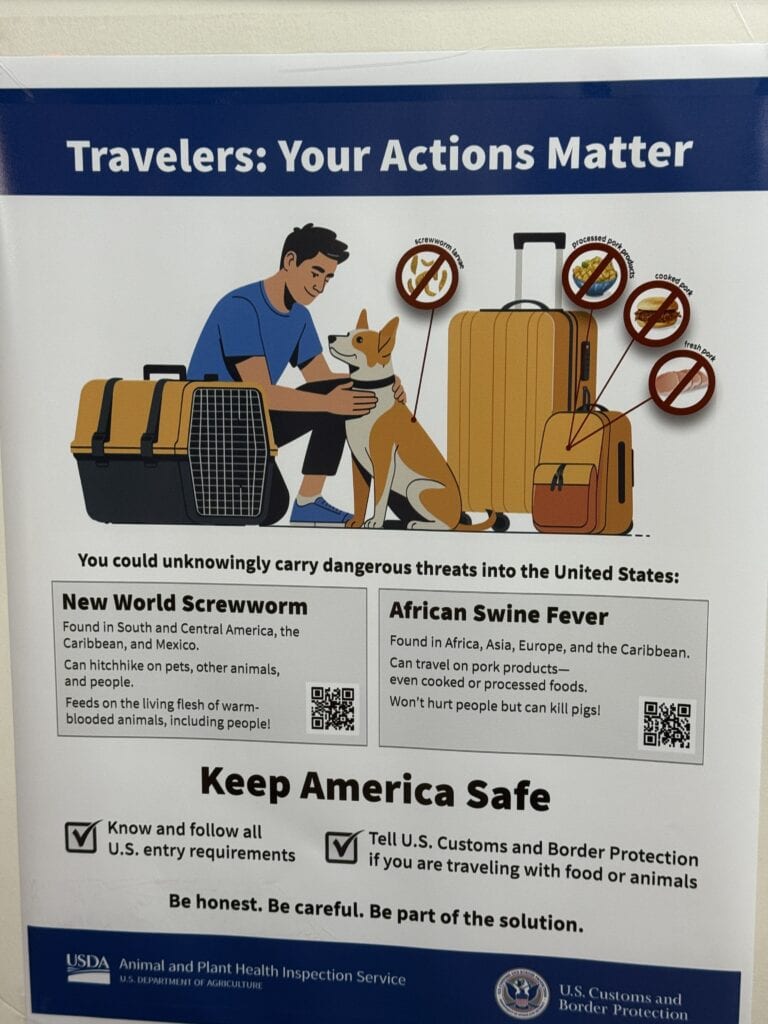
Per USDA, there has been a reports of screwworm infestations in the USA and Mexico.
While the disease is rare in household animals, the CDC takes it very seriously to not spread this harmful parasite to its livestock.
So, if you are traveling with pets from Mexico, you the USA requires a screwworm certificate for your dogs from an authorized vet.
Lifestyle: Settling Into Mexico
Once you’re in, you’ll find that Mexico is becoming more and more pet friendly.
But There Are Some Things To Know
For starters, if you’re moving from Canada or the U.S. your pet might find Mexico to be a bit loud. For some pets that can be too much to handle at first.
For example, there are some fireworks that go off during the day and night in various smaller towns in Mexico like San Miguel de Allende, Ajijic, and the like during holiday seasons. And depending on how close you are to the action, it really freaks dogs out.
Also, there can be many unleashed dogs on your walk. It’s normal here.
And depending on how social or unsocial your pet is, this could be something to get used to. So, before you go on your first walk with your dog or cat, it’s a good idea to walk the area on your own first to get an idea of what kinds of street dogs live in your neighborhood.
But luckily, pets are very adaptable as long as we ease them into their new life in Mexico.
The “Pet Resume” Trick For Landlords
Another thing you may have to consider is how “pet friendly” your next rental search might be.
And more and more landlords are allowing fur babies when you want to rent a home. Even long term rentals that don’t say “pet friendly” or “se aceptan mascotas” might let you have your fur babies with you. All you have to do is ask!
One of the most valuable tips from our Facebook community is the Pet Resume. When you are looking for a rental, don’t just ask “Are pets allowed?” Instead, give the landlord or management company:
- A cute photo of your pet.
- Vaccination records.
- A “reference letter” from a previous landlord or neighbor stating the dog isn’t a barker and doesn’t destroy furniture.
- Proof of spay/neuter.
This small professional touch might be the difference between someone allowing you to have your pets, even if the rental says they are not pet friendly.
Also keep in mind that in Mexico, many things are negotiable. If you are having trouble finding a pet friendly rental, negotiate a higher deposit with the landlord. Doesn’t hurt to ask. 😊