 Contact
  Account


If you’ve been scrolling through social media and seen chatter about U.S. and Canadian plated vehicles being seized from Permanent Residents in Baja Sur, you’re not imagining things.
I know, it sounds stressful. Being stopped at a federal checkpoint and having your car impounded is the last thing anyone wants, especially if you’ve been driving in Baja for years without issue.
At first, even I wondered if there were new laws, new regulations, or maybe some overzealous agents in Baja California Sur. But then I remembered something I always tell you: consider the source.
Much of the conversation started in a Facebook group and was amplified by a few businesses offering their own interpretations of the situation and offering the solution. It’s easy for misinformation to snowball online, especially when people are already anxious. But in this case, the concern grew far larger than the facts support.
So let’s cut through the drama and get to the facts. I’ll walk you through what’s really happening so you can plan smart, not panic.
Can Permanent Residents Drive Foreign Plated Cars in The Free Zones?
The short answer is Yes. Baja has always been one of the easiest regions in Mexico for foreign-plated vehicles, which is why this situation felt so alarming for long-time drivers.
To give you some context, you may have read or heard through the grapevine that there are recent checkpoints at KM21, just north of La Paz. And that permanent residents driving foreign plated cars were having their vehicles seized. Just for being permanent residents.
It became such big news that it caused widespread confusion, panic and uncertainty. Then like wildfire, next thing you know, there are people wanting to cancel their residency visas based on misleading information.
Here’s the practical truth: These checkpoints aren’t new. These checkpoints popup from time to time at various land borders, when the government wants to crack down on preventing illegal goods from entering Mexico or stopping unregistered cars.
So lesson learned here… consider the sources always. And maybe don’t use Facebook groups for legal advice- unless the group is specifically run by lawyers. If the federal government changes its policies on foreign-registered vehicles driven by Permanent Residents or any policies for that matter, you will see an official announcement from them.
The Difference Between Customs and Immigration
The government authority that oversees these checkpoints is usually Aduana- aka Mexican Customs- with the help of the National Guard and the State. Your immigration status isn’t relevant to these checkpoints, and whether you can drive your foreign plated car in the free zone or not.
I also confirmed with various lawyers we work with and recommend in Baja and Baja Sur- to which all of them also stated: nothing has changed. One of our lawyer contacts in La Paz even confirmed she had verified the whole story with one of the heads of government in Baja California Sur- who reassured her this was a standard checkpoint and they were not checking people’s immigration status. Only checking for contraband according to the Regla de Comercio Exterior 3.5.6
If INM- Mexico’s Immigration Authority is overseeing a checkpoint, then your immigration status matters. And what’s important is that you’re not illegally in the country or that you have permission to be in Mexico. Either you’re a resident, a tourist, or a Mexican national.
Driving In The Free Zone
When I refer to free zones in this context, I am talking about the areas of Mexico at 25km from land borders, but also including all of Baja California and Baja California Sur. Rocky Point/Puerto Peñasco. And all of Quintana Roo – which only applies if you are driving to Mexico from South America.
If you are driving in the “Free Zones” you are NOT required to apply for and get a temporary import permit TIP on a foreign plated car. Doesn’t matter if you are a temporary or permanent resident, or a tourist. You are allowed to drive your foreign plated car in this area of Mexico freely.
This exception simplifies the process for foreign-plated vehicles entering these specific regions.
The Free Zone is Different
Aduana (Mexican customs) considers your tax residency status when it comes to driving a foreign plated car in the free zones. This is different than how you are considered when driving your car outside of Mexico’s free zones.
At which point, only temporary residents, tourists and Mexican nationals living abroad can drive a foreign plated car with a Temporary Import Permit (TIP). They consider you a tax resident of Mexico if you are primarily living in Mexico. However, If you have a home in Mexico, and another country, you’re considered a tax resident of Mexico if:
- More than 50% of your income is generated from Mexican sources, or
- Your main job is in Mexico
So basically, there is permanent residence for immigration purposes and permanent residence for tax purposes. If you are exempt under their interpretation of being a tax resident, then you can drive your foreign plated car in the free zones freely.
In case you are wondering how to ensure you comply with driving a foreign plated car in Mexico’s Free Zones, you should carry your current and valid car’s registration in your name, a valid and current foreign driver’s license, and Mexican auto insurance.
Mexico Is Consistently Inconsistent
One thing I want to point out, that is very hard for people coming from North of the Border to wrap their heads around is just how different things in Mexico work.
It’s constantly referred to as consistently inconsistent. Because one government agent might interpret things one way, and the next one might tell you something different.
And while the current operation at KM21 is meant to catch any contraband, that doesn’t mean there isn’t one or two agents who might take advantage of the panic amongst the foreigner community and ask for a “donation” from a resident with foreign plates.
It happens.
Having foreign plates is often times a great way to tell a transit agent you’re not from around here.
So, if you’re planning to live in Mexico long term, I would highly recommend buying a Mexican car. Not only will it squash any grey areas of whether or not you can drive freely throughout Mexico, but having Mexican plates also helps you blend in more.
But there are also other benefits. You’ll also have the freedom to sell a Mexican car to anyone in Mexico- not just foreigners. You won’t have to worry about temporary import permits, and extending these to match your temporary residency visa. And you can get a standard, full-coverage Mexican insurance policy instead of a special policy for a foreign-plated car.
It’s also cheaper over time since you won’t have to worry about import fees or high temporary import deposits.

Mexican Citizens Driving in The Free Zones
Now, you may be wondering.. what about Mexican citizens?
If a Mexican citizen drives a U.S. plated vehicle in the free zones, without applying for a temporary import permit and there is no U.S. citizen in the vehicle?
If you are a Mexican citizen and you don’t have U.S. documentation, the vehicle will be permanently confiscated by Mexican customs. Mexican citizens are NOT allowed to drive foreign plated cars in Mexico’s free zones. The Mexican citizen can incur a large fine of 80% of the vehicle’s value.
Mexican citizens are allowed to apply for a temporary import permit to drive in Mexico for up to 180 days, as long as they have lived abroad for at least one year and can prove it. To prove to aduana you live abroad, they will usually ask for a Resident Card from the U.S.- aka green card. They may also check the stamps on your Mexican passport.
Driving Beyond The “Free Zone”
Driving anywhere outside of the border zone means you have to have permission in the form of a TIP for your foreign-plated vehicle to be in Mexico. Failure to show you have this permit by a random checkpoint means you could have your car seized, and you might have to pay a hefty fine of 80% of the vehicle’s value.
Don’t worry; the process for getting a TIP is straightforward and can only be done at land border crossings.
🛣️ A Few Driving Realities to Keep You Safer
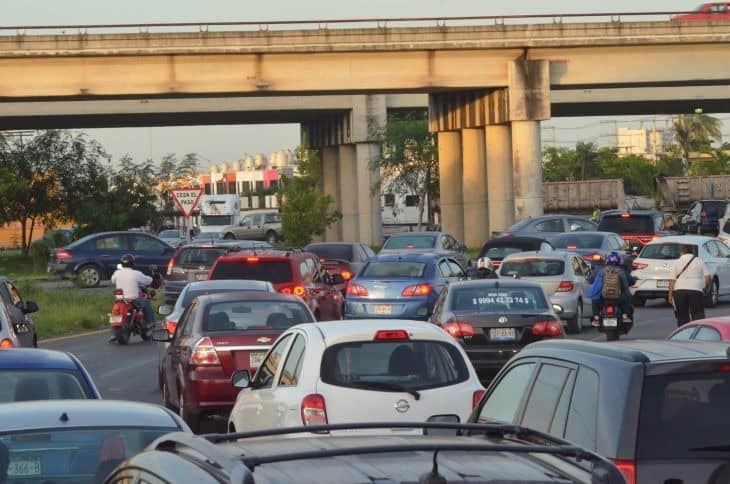
Since we’re talking about driving, I wanted to quickly remind you of a few “Mexico-specific” road realities that are crucial, whether your plates are U.S., Canadian, or Mexican:
- Units are Metric: Speed and distance are in kilometers, and gas is sold by the liter. (It’s smart to know your tank size in liters so you can watch the pump!)
- The Shoulder is a Slow Lane: On many two-lane highways, if you aren’t actively passing, move onto the shoulder to let faster drivers pass you by. It’s expected!
- Left Signal Means Pass Me: If the driver in front of you signals left on a straight road or highway, they are usually signaling that it’s safe for you to pass them—not that they’re turning.
- Stop Signs are Yield Signs (Sometimes): Stop signs (ALTO) are often treated like yield signs if the road is totally clear. Be cautious, but don’t be shocked if locals just roll through.
- Topes: Speed bumps (topes) can be tall and totally unmarked, especially on free highways. This is one of the big reasons I recommend highway driving during daylight hours.
- Tolls Need Cash: While a PASE tag helps on toll roads, always carry cash because scanners go down all the time.
- Your U.S. or Canadian auto insurance is NOT valid in Mexico.
Living in Mexico Means Being Flexible
I get it, this car situation is frustrating and confusing. But the authorities are just following orders. They are NOT targeting expats.
This gap between the rules on paper and real-life enforcement is common in Mexico. As systems improve and modernize, sometimes interpretation can get lost in the shuffle. But there is nothing here that requires panic or a rushed decision. In fact, nothing has actually changed. Take a breath.