 Contact
  Account


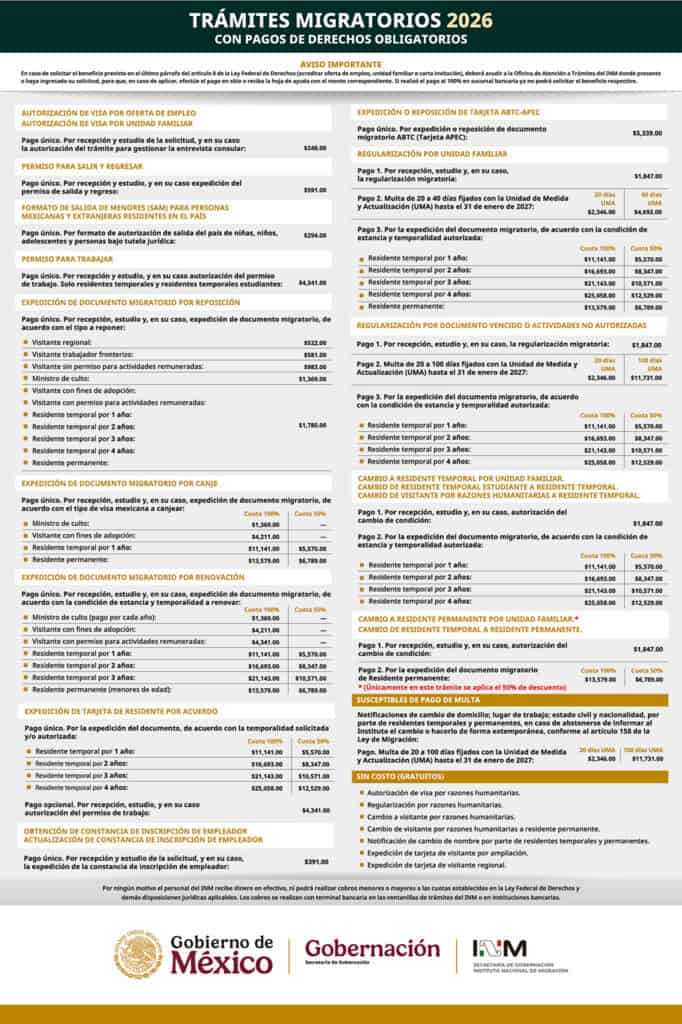
If you are applying to become a resident in Mexico, there are specific immigration fees you should be aware of. These usually increase each year and are different based on which residency visa or immigration process you will be applying for. The Mexican government has published its annual updates to the Ley Federal de Derechos, introducing new government fees that will take effect on January 1, 2026.
Check out our Mexican resident visa guide for a full explanation of the application process for both a temporary and permanent resident visa (beyond fees).
Fees are typically paid at a local bank using a pre-generated help sheet or via credit/debit card at some INM offices. If you cannot pay via debit/credit card for things like your residency visa or anything that is paid at the INM offices, then there is an option to pay at authorized banks and bring your payment receipt to INM. Please review the official fee schedule for the most up-to-date charges and fines.
If you are applying outside your jurisdiction, please contact the nearest Consulate General for assistance or clarification regarding your application or fees. For any questions or to schedule an appointment, contact the appropriate office directly.
Introduction to Immigration
Moving to Mexico is a process that involves several important steps and requirements, all overseen by the National Migration Institute (INM).
Whether you’re considering a temporary or permanent move, understanding the different types of residency visas is essential. The Mexican government has established clear immigration procedures to help foreign nationals enter Mexico legally, and these are governed by the Ley Federal de Derechos (Federal Fees Law), which sets out the government fees for each stage of the process.
To begin you’ll need a valid passport and, depending on your nationality and purpose of stay, possibly a visa.
The application process for a residency visa—whether temporary or permanent—requires careful attention to detail, as each type of visa has its own set of requirements and associated fees.
The INM is responsible for managing these immigration processes, ensuring that all foreign nationals comply with Mexican law as they seek to establish residency. By familiarizing yourself with the procedures and requirements, you can better plan your move and avoid common pitfalls along the way, especially when you follow a clear five-step process for moving to Mexico.
Government Requirements
The Mexican government has established a set of requirements that all foreign nationals must meet to obtain a residency card.
This process starts with submitting a formal application and paying the necessary government fees, as outlined in the federal fee law.
Applicants are required to provide a range of documentation, including a valid birth certificate, marriage certificates if applying with a spouse, and proof of employment or sufficient financial resources to support themselves in Mexico.
The Instituto Nacional de Migración (INM) is the authority responsible for reviewing applications and issuing residency cards.
Depending on your situation, you may also need to provide additional documentation, such as evidence of family unity or an employment contract.
In some cases, applicants may qualify for a 50% discount on certain fees, particularly when applying under family unity residency provisions, but eligibility is determined on a case-by-case basis and must be clearly documented.
It’s important to gather all required documents before starting your application to avoid delays. Each step of the process is governed by the federal fee law, so fees may vary depending on the type of residency visa you are applying for and your personal circumstances. By ensuring your documentation is complete and accurate, you’ll be better positioned to obtain your residency card smoothly.
Visitor Visa (tourist)
When you travel to Mexico as a tourist or a foreign resident who requires it for travel, you will either drive across the border, fly in or take a cruise. And in case you didn’t know this, there is a fee that Mexico charges foreigners to process their FMM or forma migratoria multiple, which is essentially your tourist permit to travel around Mexico.
The 2026 cost of this is $983 MXN (about $53 USD). Visitor visas/permits (FMM) cost approximately 983 MXN (about $57-$58 USD) for stays up to 180 days.
You can pay for your FMM at the INM offices on the land borders if you are driving across. The issuance of the FMM at these offices is important, as you must carry it as proof of legal entry while in Mexico. However, if you are traveling to Mexico for less than 7 days, it is free.
All foreign tourists must stop at INM on their way into Mexico and process their FMM even if you are staying for just a day or two. There are checkpoints where, if you get caught without an FMM, you can be sent to a temporary immigration jail.
If you are a resident or national of Mexico, you don’t need to stop at INM or pay the FMM fees.
If you are flying to Mexico, the airline automatically charges you this amount when you reserve and pay for your ticket. No need to pay for this again. If you are not a tourist, you can apply for a refund. But in my experience, getting a refund is a marathon.
If you are taking a cruise to Mexico, the cruise line automatically charges its passengers for this permit to enter Mexico. However, you aren’t given an FMM as you’d normally get if you were flying or driving to Mexico.
Mexican Consular Fee
- $56 USD
- $80 CAD
The consular fee is paid at the Consulate General responsible for your jurisdiction. This fee covers the visa issuance process and is separate from the application processing fee. If you are applying outside Mexico, there is a separate consular fee typically around $50-$60 USD charged by the Mexican Embassy or Consulate. Application processing fees incur a separate charge of approximately $56 USD for visa interviews initiated outside Mexico.
Keep in mind the consular fee is paid upfront and is non-refundable if you are not approved for your residency. All of these fees also go up yearly.
The following is a list of all immigration fees paid in Mexico at INM for residency purposes with the most current changes.
These are also known as Pago de Derechos by the National Institute of Migration or INM. All fees in Mexico are listed in Mexican Pesos.
Changing Your Residency Status Fee
The first fee you must pay the Immigration Authorities in Mexico is for receiving your case, analyzing it, and covering the change in status from Tourist to Temporary Residency, for family unity, or to become a Permanent Resident.
You also pay this fee when switching from Temporary to Permanent Resident.
The cost of this change in your residency status is $1,847 MXN in 2026. Plus the cost of your temporary or permanent residency visa. You would also pay this fee if you needed to replace a lost or stolen residency visa.
After paying this fee, the issuance of your new residency status will be processed by the immigration authorities, who will review your documents and provide the official residency card.
The fee for converting a temporary residency card to a permanent residency card will be $13,579 MXN in 2026.
Temporary Residents
The first part of your residency process will almost always start in your home country. You have to secure a Mexican consulate appointment, and they will check to see if you qualify for residency in Mexico.
The second part of the process takes place in Mexico and is known as CANJE.
Because most Temporary Residents are initially given their residency card for one year, the current cost of this is $11,141 MXN (about $620 USD) for 2026. You pay this along with the change of status fee as part of the canje residency exchange process.
After the first year, you will have to renew your residency visa, and it can only be done for an additional 3 years. It’s also important to understand the specific Mexican residency income requirements for 2025, since financial criteria often influence which residency options you qualify for. In 2026, the temporary residency visa fees are:
- 1 Year: $11,141 MXN (about $620 USD)
- 2 Years: $16,693 MXN (about $930 USD)
- 3 Years: $21,143 MXN (about $1,175 USD)
- 4 Years: $25,058 MXN (about $1,390 USD) – only open to regularization applicants.
Immigration fees in Mexico for 2026 have increased quite a bit with official residency card fees effectively doubling for many applicants compared to 2025.
However, a 50% discount on the residency card fee is available for applicants under the Family Unity category or Employment Offers. If applying based on financial solvency, the applicant will pay the full amount without the 50% discount, and should also be aware of possible changes to residency income requirements based on UMA.
Foreign residents should review the official fee schedule for the most current charges, fines, and eligibility for discounts.
When you come to Mexico, you pay this amount to finish your process at the INM offices. You pay this along with the application/change of status fee.
Permanent Residents
If you are given permanent residency at the Mexican Consulate that approved your residency, your visa is indefinite and does not need to be renewed. You only pay $13,579 MXN once. In 2026 this is about $734 USD. This is the fee for converting a temporary residency card to a permanent residency card.
When you come to Mexico, you pay this amount to finish your process at the INM offices. You pay this along with the application/change of status fee. After payment, you will be issued a permanent residence card, which is essential for maintaining your legal status in Mexico and for re-entering the country. Holding a valid permanent residence card can also exempt certain travelers from needing a visa for entry into Mexico.
Residency Card
A residency card is your official proof of legal status as a foreign national living in Mexico. Issued by the INM, this card contains key information such as your name, nationality, address, and whether your residency is temporary or permanent. To obtain a residency card, you’ll need to submit your application and all supporting documents to the INM offices in the state where you plan to live.
The application process involves several steps, including paying the required fees as set out in the federal fee law. Depending on your situation, you may need to provide additional documentation, such as a job offer or employment contract, to support your application. Once your documents are reviewed and your application is approved, you’ll receive your residency card, which serves as your legal identification in Mexico.
Keep in mind that temporary residency cards must be renewed periodically, while permanent residency cards do not require renewal. It’s essential to keep your residency card up to date and to notify the INM of any changes in your personal information or status. Having your residency card in hand not only proves your legal right to live in Mexico but also makes it easier to access services and complete other official processes.
Family Unity Discount
There is a 50% discount for family members applying under family unity. This discount is also available for applicants under the Employment Offers category.
Note: Eligibility for the 50% discount is subject to strict documentation and classification requirements. Not all applicants will qualify, and the discount is not automatically granted. In cases involving minors, a legal guardian must be involved in the application process for family unity discounts, and additional documentation may be required to prove the relationship and authorization.
But I want to be very clear here, because this is where people get surprised and frustrated: Just because a discount exists does NOT mean you will automatically receive it.
This discount is conditional, it’s case-by-case, and it depends heavily on how your file is classified inside INM’s system. In other words, you can have a completely legitimate family unity case and still be told the discount does not apply to your situation.
It usually comes down to how your case is categorized and whether your paperwork meets the exact requirements being enforced at your local INM office at that time.
Here are a few common reasons the discount may not apply:
- If your residency process started at a Mexican consulate, your dependent needs to be marked correctly as “Family Unity” from the beginning
- Your documents need to match perfectly, including apostilles and translations (especially marriage certificates)
- If there are discrepancies in your paperwork — even small ones like name differences, spelling issues, or affidavits — the discount may be denied
- This discount typically does not apply to a change in condition, such as switching from temporary to permanent residency
And those are only a few examples.
The reality is that INM can treat this discount differently depending on the office and the case, and the requirements can change without much warning. That’s exactly why working with a reputable immigration facilitator can make a huge difference, they know what your local office is actually doing right now, not what the internet says.
One more important thing people don’t think about:
Requesting the discount can sometimes lead to more scrutiny on your case.
That can mean more questions, more document verification, and a longer overall process. This matters a lot if you’re doing your canje in Mexico, because in many cases you cannot leave Mexico until your residency card is issued and your process is complete.
So yes, if you qualify for the discount, it can absolutely be worth pursuing.
But if you’re traveling, working on a tight timeline, or you can’t stay in Mexico long enough to deal with delays, sometimes the smartest move is to focus on getting approved smoothly and quickly instead of trying to save money upfront.
My best advice: budget as if you will pay the full amount, and if you receive the discount, treat it as a bonus.
It’s also important to keep in mind that things can change very quickly… And they often do in Mexican bureaucracy. Especially when something in the system is “new”. So bookmark this page to get the latest info as we have updates.
Work Permit for Temporary Residents
If you wish to work in Mexico as a temporary resident, you must obtain permission to work from INM. Even if you rent an Airbnb in Mexico as a temporary resident, you have to ask INM for permission to work—because you are generating an income.
The cost of this work permit is $4,341 MXN for 2026. The issuance of a work permit for temporary residents is handled by INM, and obtaining official authorization is essential before starting any employment activities.
Permanent Residents are given permission to work without having to process any additional permits. You are supposed to notify INM of your intent to work and what you plan to do.
Exit and Re-Entry Permit
Any new resident of Mexico who is coming to process their canje (the exchange of their residency stamp for a residency card) CANNOT leave Mexico without written permission from INM. Doing so will cancel your residency process, and you will have to start over again.
For this, INM has a special exit and re-entry permit for people in special circumstances. With this permit, you are allowed to leave Mexico for a period of up to 60 days. At this point, you will have to come back to Mexico and cannot leave until you have your residency card in hand.
The cost of this permit is $591 MXN in 2026. The issuance of the exit and re-entry permit is handled by INM and is granted under specific conditions, such as pending residency processing or urgent travel needs.
Immigration Fines
In some cases, some residents may be subject to INM fines for failure to notify INM of changes in their address in Mexico, changes in their marital status if you obtained residency through your spouse, and/or change in employment if you obtained residency through a job offer.
These fees vary depending on each case. They vary from 20 UMAs to 100 UMAs. UMA is a measure the Mexican government uses to calculate fines, mortgage rates, and various other payment topics. They change yearly, and can be found here. The fee schedule outlines the standard charges and penalties for immigration process violations. Fines for non-compliance with immigration regulations in Mexico can range from 20 to 100 days of UMA.
Benefits for Permanent Residents
Becoming a permanent resident in Mexico comes with a range of valuable benefits. As a permanent resident, you have the right to live and work in Mexico without restrictions, giving you the freedom to pursue employment or start a business. Permanent residents also gain access to public healthcare, education, and other social services provided by the Mexican government, many of which are covered in detail in our expat guide to living in Mexico.
One of the most significant advantages is the ability to apply for a Mexican passport, which can simplify international travel and make re-entering Mexico much easier. To qualify for permanent residency, applicants typically need to have held a temporary resident visa for a certain period, demonstrate strong ties to Mexico—such as through family unity or a stable employment contract—or meet other criteria set by the government.
For foreign nationals seeking long-term stability and the full range of rights available in Mexico, permanent residency is an attractive option. It not only secures your legal status but also opens the door to greater opportunities and integration into Mexican society, especially if you combine it with relocation tours across different Mexican cities to find the best place to settle.
Common Challenges
While the process of immigrating to Mexico offers many rewards, foreign nationals often encounter a few common challenges along the way. Navigating the application process can be complex, especially when it comes to gathering the correct documentation, understanding the required fees, and meeting all government requirements. Language barriers and unfamiliarity with Mexican bureaucracy can add to the difficulty, sometimes resulting in delays or requests for additional information.
Applicants may also face issues such as missing paperwork, unclear instructions, or unexpected changes in regulations. These challenges can be frustrating and time-consuming, particularly if you’re unfamiliar with the procedures or need to coordinate with the Mexican consulate or other authorities.
To make the process smoother, it’s a good idea to seek guidance from the INM, the Mexican consulate, or a qualified immigration expert who understands the latest requirements and can help you prepare your application correctly.
Learning how to schedule Mexican consulate appointments online can also help you secure interviews faster and avoid common booking issues. By staying informed and organized, and by reaching out to Mexican authorities when needed, you can minimize obstacles and ensure a more successful transition to life in Mexico.
Who Can Help You To Obtain Residency in Mexico?
Mexican bureaucracy can be challenging and time-consuming, especially for anyone who has never had to deal with immigration in Mexico. Making use of must-have apps for living in Mexico can also simplify everyday tasks like banking, transportation, and communication.
And although it isn’t impossible to process your residency on your own, the process can be frustrating and confusing. So, who can help you ensure you have a smoother experience?
Hiring An Immigration Facilitator
However, remember that an immigration facilitator’s fees are on top of immigration fees. And you can expect to pay an immigration facilitator anywhere from $4,000-$8,000+ MXN per person (approx. $230-500 USD). Depending on who you hire, what services they offer, how much they will do for you or expect you to do on your own, how many people in your family they are helping, and a few other factors.
A good and reputable immigration facilitator in Mexico can help guide you through the residency process in Mexico. And because the process varies slightly from one INM office to another in Mexico, it’s important to hire a facilitator familiar with local norms.
Hiring a local expert who knows the immigration processes will not only save you time, but it can save you money. Not to mention saving you some frustrations.
Because of this, I have put together a directory of my recommended immigration facilitators across Mexico. I have them in a variety of cities in different states of Mexico. If you’d like one of our recommendations, check out our COMPLETE Mexico Relocation Guide.